Get new posts by email
Enjoying the blog? Help with costs & future trips.
Aire & Cut Ale Trail – Leeds
A day exploring some of Leeds’ best pubs, brewery taps and historic drinking spots, starting at Kirkstall Bridge and working back towards the city centre. Along the way I visited everything from grand Victorian pubs and cosy traditional locals to modern brewery taprooms and riverside bars. There was plenty of cask ale to choose from, with beers from Kirkstall, Leeds Brewery, Small World and others along the way. I also called at Northern Monk, The Tetley and Piglove by the River, finishing the day beside the River Aire. A great mix of history, character, good beer and some brilliant Leeds pubs.
Follow the full Aire & Cut Ale Trail
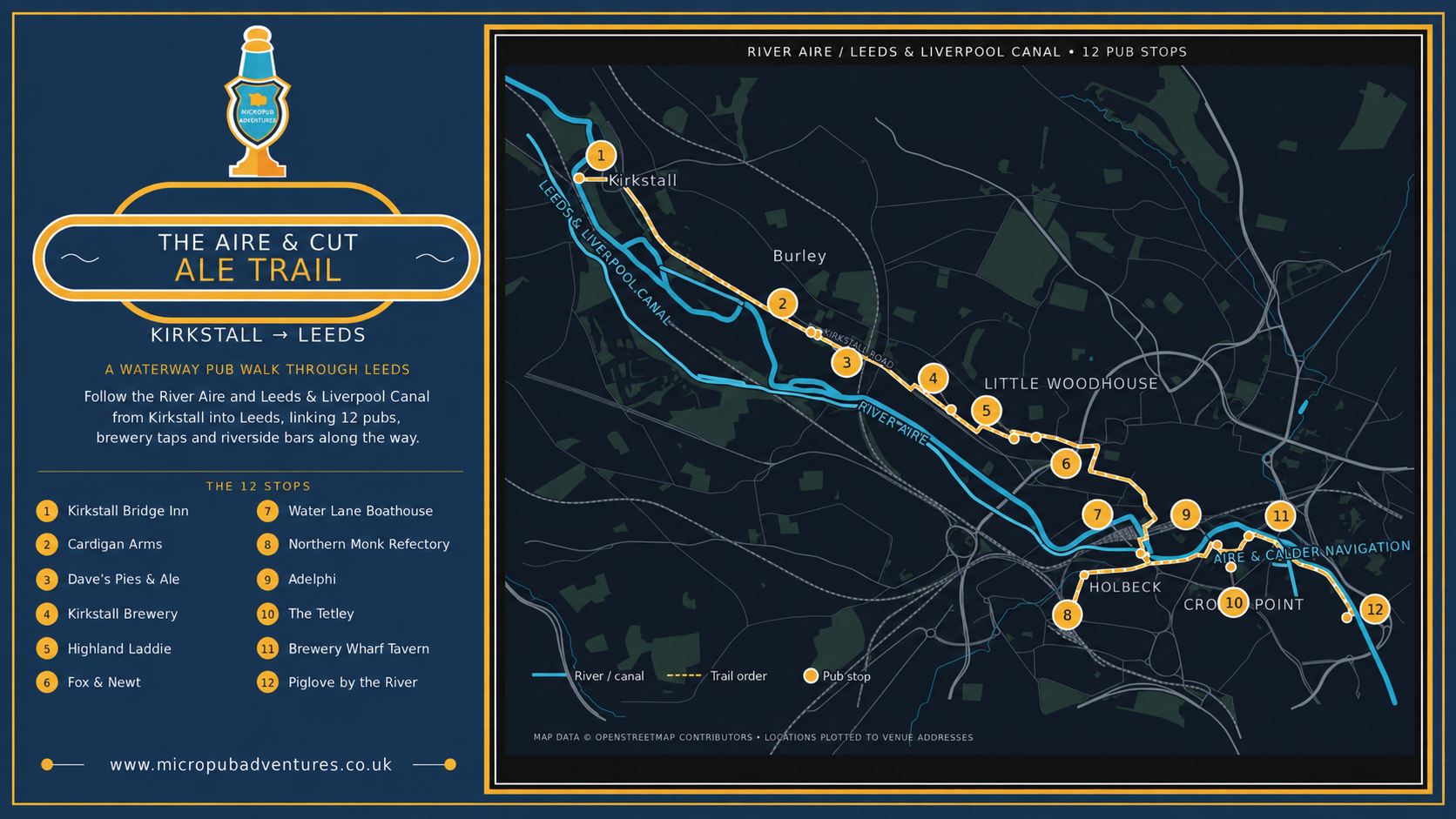
Fancy following the route yourself? The Aire & Cut Ale Trail links 12 pubs and beer stops from Kirkstall into Leeds, following the River Aire and Leeds & Liverpool Canal corridor.
Kirkstall Bridge Inn
I started the day at Kirkstall Bridge. The Kirkstall Bridge Inn is thought to date from the late 1700s and has long stood beside the River Aire at Bridge Road. By 1873 it was known as the Bridge Inn, when the old Kirkstall Brewery Company leased the pub, later buying it outright in 1895. Over the years it also traded as the Old Bridge Inn. The modern Kirkstall Brewery bought the freehold in 2011, making it the first pub in its estate. A major refurbishment followed in 2013, carefully keeping the character of the stone building. Today, it continues the site’s long connection with brewing in Kirkstall.
Inside, the Kirkstall Bridge Inn has a warm, traditional pub look, with dark wood, wooden floors and old brewery mirrors and signs on the walls. The main bar is at road level, with wooden tables, chairs and benches around the room, while a small snug sits tucked away behind the bar. Down the stone stairs is a second bar with the same cosy, traditional style. Outside, there’s a large beer garden with paved and grassy areas, plenty of picnic benches, mature trees and outdoor lights. It sits beside the river and looks across towards Kirkstall Bridge, making it a lovely spot for a drink.
There were 8 cask ales alongside a wide variety of keg options. I went for Abbey Ale 2026 by Kirkstall Brewery, an English pale ale with fruity flavours, a touch of banana and a smooth, malty finish.
The Cardigan Arms
Next up was The Cardigan Arms. The Cardigan Arms opened in 1893 on Kirkstall Road, built as the surrounding Burley area was growing rapidly. Designed by Leeds architect Thomas Winn, it was created as a grand Victorian pub for the new neighbourhood developing on the Earl of Cardigan’s estate. The building included its own brewhouse and stables, and much of its original character has survived. It later became part of the Tetley estate and was given heritage status by the brewery in 1989. The pub was Grade II listed in 1994. Kirkstall Brewery later took it on, carefully restoring the building and reopening it in 2017.
Inside, the Cardigan Arms is packed with warm Victorian character, with dark polished wood, etched and stained glass, old mirrors and lots of decorative detail. The main bar curves around the centre, with brass rails, traditional handpulls and carved woodwork. Around it are several smaller seating areas, with leather benches, wooden tables, stools and patterned carpets giving each one a cosy feel. Old brewery mirrors and signs add plenty of character, while the coloured glass windows really stand out. There are also quieter corners and snug-like areas, all keeping that classic traditional pub look throughout.
There was a choice of 7 cask ales alongside a huge range of keg options. I went for Blonde by Kirkstall Brewery, an English blonde ale with citrus, stone fruit and orange flavours and a smooth, clean finish.
Dave’s Pies and Ale
Just along the road was Dave’s Pies & Ale. Dave’s Pies & Ale is a newer arrival on Kirkstall Road, opening in November 2021. It was created by Dave Knowlson and his partner Andy Turner after Dave began making pies during the Covid lockdowns while managing The Grove in Holbeck. The idea grew from restoring an old pie press and selling pies to friends and regulars. The Kirkstall Road unit had been empty for nearly two years and had previously been a sandwich shop and later a gin bar. After a three-month fit-out, the small venue opened as a traditional-style pub combining homemade pies with locally brewed cask ale.
Inside, Dave’s Pies & Ale is small, cosy and packed with character. Deep green walls are covered with old brewery mirrors, signs and beer memorabilia, while dark wood runs through the bar, seating and stained-glass screens. The compact bar sits neatly in the middle, with a few stools around it and hanging glasses above. Small tables and booth-style seating fill the front room, with big windows looking out onto Kirkstall Road. There is also a tucked-away seating area with padded benches and its own table. It all feels warm, traditional and nicely lived-in, with something interesting to spot almost everywhere.
There were 3 cask ales, a couple of keg choices and a fridge full of bottles and cans to choose from — and don’t forget the pies! I went for Barncliffe Bitter by Small World Beers, a light session bitter with a crisp taste and a lasting bitter finish.
Kirkstall Brewery Tap & Kitchen
Heading back towards Leeds brought me to Kirkstall Brewery. Kirkstall Brewery Tap & Kitchen is a newer addition to Leeds’ pub scene, opening in 2022 at the brewery’s Kirkstall Road home. Kirkstall Brewery itself was established in 2011, close to the site of the old Kirkstall Brewery, which had brewed in the area from the 19th century until 1983. The brewery moved into its larger Kirkstall Road site in 2017, giving it room to expand production. The taproom followed a few years later, creating a place where visitors could drink the brewery’s beers right beside where they are made. It has since become a popular stop for beer lovers.
Inside, Kirkstall Brewery Tap & Kitchen brings together an industrial brewery setting and the warmth of a traditional pub. Exposed concrete ceilings, beams and pipework sit alongside dark wood panelling, old brewery mirrors, signs and framed memorabilia. The room is filled with wooden tables, mixed chairs, stools and leather bench seating, with warm pendant lights and chandeliers adding a cosy glow. The bar has a classic pub look, with plenty of wood and brass details. Large windows look straight into the working brewery, where the stainless-steel tanks and pipework can be seen, giving the place plenty of character.
There were 7 cask ales alongside a huge selection of keg beers, with even more choice from cans and bottles. I went for Bitter by Kirkstall Brewery, a traditional bitter with amber malt, forest fruit notes and a refreshing bitter finish.
The Highland Laddie
A short walk brought me to The Highland Laddie. The Highland Laddie on Cavendish Street has been serving Leeds for around a century. The pub was refurbished in 1923 by Warrington brewers Peter Walker, and parts of that old two-room layout and fittings still survive. For many years it was known as The Highland and became a familiar local for nearby residents and workers. The pub closed in 2023, but its story did not end there. Sam Pullan and Nicole Deighton, the team behind Empire Café, took it on and carefully brought it back to life. It reopened on 17 April 2025, returning to the older Highland Laddie name.
Inside, The Highland Laddie has a warm traditional look, with dark walls, rich red ceilings and plenty of polished wood throughout. The main room has deep red curtains around the windows, old portraits on the walls and warm lamps adding a cosy glow. There’s a small brick fireplace with a stove, along with antlers and other old-fashioned touches dotted around the room. Dark leather bench seating runs beneath the stained-glass windows, with wooden tables and stools filling the space. The long wooden bar fits in perfectly with the rest of the pub. It was also great to bump into Graham and Martin again, who I last saw in Skipton.
On the bar was a selection of 4 cask ales alongside a varied range of draught choices. I went for Three Horseshoes by Ashover Brew Co., a blonde ale with floral and herbal hop flavours and a light, dry finish.
The Fox & Newt
Just around the corner brought me next to The Fox & Newt. The Fox & Newt on Burley Street started life around 1900 as the Rutland Hotel, part of a distinctive row of buildings close to Leeds city centre. The name was later changed to the Fox & Newt, and the pub became well known for brewing beer on site. Whitbread installed a brewery in the cellar, with brewing beginning in December 1982. Production stopped and restarted several times over the following years, later operating as the Burley Street Brewhouse. Brewing is currently suspended, but the Fox & Newt remains open, keeping a long-running Leeds pub tradition going on Burley Street today.
Inside, the Fox & Newt has a warm, traditional pub look, with dark wooden floors, wooden tables and stools, and plenty of comfortable bench seating. Cream walls are broken up with deep purple brickwork and grey panelling, while large gold-framed mirrors help brighten the room. One corner has an old decorative fireplace, with stained-glass windows and small wall lights adding more character. The main room feels open but still has little areas to sit in, including cosy booths by the windows. The bar has a classic pub look too, with stained glass above and traditional handpulls across the front.
There were 2 cask ales on the bar alongside a variety of draught choices. I went for Yorkshireman Blonde by Craven Brew Co., a blonde ale with light citrus and fruity flavours and a clean, refreshing finish.
Water Lane Boathouse
A longer walk through Leeds brought me to Water Lane Boathouse. Water Lane Boathouse sits beside Lock Number One at Canal Wharf, in a building dating from the early 1800s. It was originally used as a transhipment warehouse for the Leeds and Liverpool Canal, moving goods between boats and the growing city. The building later became a granary storehouse, keeping its close link with the busy waterside. In more recent years it housed several bars and restaurants, including The Pour House. Water Lane Boathouse opened in April 2017, created by the team behind Belgrave Music Hall and Headrow House, giving the old canal building another new chapter as a waterside pub.
Inside, Water Lane Boathouse feels bright, open and relaxed, with a mix of industrial details and warmer touches. Exposed concrete ceilings, pale beams and dark metal lighting sit above wooden floors, while stone walls and deep green sections add plenty of character. The bar stands out with its green and white patterned front, wooden shelving and rows of bottles behind. There’s a mix of long wooden tables, benches, stools and softer seating, with different areas to settle into. Huge windows bring in lots of natural light, while the doors open straight out towards the busy canalside terrace and water beyond.
The cask taps were being repaired during my visit, although there are usually 2 cask ales available, alongside a wide range of draught options. I went for Virtuous by Kirkstall Brewery, a session IPA with citrus and tropical fruit flavours and a clean, refreshing finish.
Northern Monk Refectory
Onto Northern Monk Refectory. Northern Monk Refectory sits inside the Old Flax Store at Marshall’s Mill in Holbeck. The Grade II listed building dates from Leeds’ industrial past, when it was used to store flax for John Marshall’s textile business. Northern Monk was founded in 2013 and moved into the building in 2014, turning the previously derelict site into its first permanent brewery. The brewery was installed on the ground floor, with the Refectory taproom opening above it in October 2014. A further events space, now known as the Chapter Hall, occupies the upper floor, keeping this historic mill building in active use today.
Inside, Northern Monk Refectory has a warm, relaxed look, with plenty of character from its old industrial setting. Exposed brick, black metal columns and large silver ducting run through the room, while big windows bring in lots of natural light. Wooden tables and benches fill the main seating area, with a few plants dotted around to soften things up. The dark green tiled bar fits in well with the industrial style, while warm pendant lights and small strings of lights add a cosy touch. Outside, the courtyard has plenty more seating, with wooden picnic tables surrounded by brickwork, artwork and old industrial buildings.
There were 3 cask ales alongside a huge choice of keg beers covering a wide range of styles and strengths, with plenty more cans available too. I went for Citrazacca by Truth Hurts Brewing, an American pale ale with mango, guava, pineapple and pine flavours and a fresh, hoppy finish.
The Adelphi
Next up was The Adelphi. The Adelphi on Hunslet Road was built in 1897–98 for the Leeds & Wakefield Breweries company, later known as Melbourne Brewery. Designed by Leeds architect Thomas Winn, it was created as a grand Victorian pub and hotel close to Leeds Bridge. Its curved corner frontage and richly decorated interior made it one of the city’s more impressive drinking houses. Tetley’s took over Melbourne Brewery in 1960, bringing the Adelphi into its large Leeds pub estate. The building was Grade II listed in 1994, recognising its architectural importance and remarkably well-preserved interior. Today, it remains one of Leeds’ best-known historic pubs.
Inside, the Adelphi is full of traditional character, with dark wood, etched glass and patterned tiling running through the different rooms. The curved wooden bar is a real feature, with brass fittings, old-style mirrors and warm hanging lights adding to the look. Around the pub there are cosy corners with bench seating, wooden tables and chairs, decorative plasterwork and large windows bringing in plenty of natural light. The old glass screens and tiled hallway give the place plenty of detail, while the front rooms each have their own feel. Out the back, there is also a sheltered beer garden with wooden seating, plants and strings of lights.
There were 3 cask ales to choose from on the bar, alongside a wide variety of keg options. I went for Leeds Pale by Leeds Brewery, an English pale ale with light citrus and floral hop flavours and a clean, refreshing finish.
The Tetley
My next visit was to The Tetley Pub. The Tetley stands in the former headquarters of Joshua Tetley & Son, the brewery that shaped this part of Leeds for generations. Joshua Tetley bought the brewery site in 1822, while the Art Deco headquarters building opened in 1931. Tetley’s later became one of the world’s biggest producers of cask ale. Brewing in Leeds ended in 2011 and much of the surrounding brewery was demolished. The headquarters survived and reopened in 2013 as a contemporary art gallery. That closed in 2023, and Kirkstall Brewery took over the building in 2024, bringing beer and hospitality back to this famous Leeds landmark.
Inside, The Tetley still feels closely connected to its brewing past, with old signs, brewery memorabilia and display cabinets filled with pieces from its history. Dark leather sofas, red armchairs and wooden tables create comfortable little seating areas, while the open layout keeps everything feeling bright and relaxed. One of the most striking features is the exposed brick section carrying old Tetley brewery lettering, with metal railings and an upper level above. There is also an impressive First World War memorial dedicated to Tetley employees. With old advertising, brewery details and plenty to look at, the building has loads of character throughout.
On the bar were 4 cask ales alongside a huge selection of craft keg options. I went for Bitter by Kirkstall Brewery, a traditional bitter with malty flavours, gentle fruit notes and a refreshing bitter finish.
Brewery Wharf Tavern
A short walk away was Brewery Wharf Tavern. Brewery Wharf Tavern opened on 29 August 2025, bringing a pub back to this riverside spot beside the River Aire. Its name comes from the area’s past, as this was once the site of the riverside delivery wharf serving the historic Tetley Brewery. The premises were previously home to Home restaurant, which closed in 2024, and before that the well-known Oracle bar and nightclub. The new tavern was opened by the team behind Whitelock’s Ale House, Meanwood Tavern and White Cloth Hall. Today, it carries on the area’s long connection with Leeds brewing in a relaxed riverside setting.
Inside, Brewery Wharf Tavern is bright, colourful and full of character. The room has a warm mix of wooden flooring, red tables, red and burgundy seating and long padded benches running around the walls. The curved bar sits to one side, with a patterned tiled floor around it and polished fittings adding a smart touch. Overhead, the copper-coloured ceiling catches the light, while bold colourful artwork runs around the room and across a large feature wall. Big windows bring in plenty of natural light, and the mix of booth seating, smaller tables and stools makes it feel relaxed, welcoming and easy to settle into.
There was 1 cask ale on the bar, usually 2 although one had run off, alongside a fantastic line-up of craft keg options. I went for Berry Sour by The Five Points Brewing Company, a fruited sour with blueberry and raspberry flavours and a tart, refreshing finish.
Piglove by the River
My final visit of the day in Leeds was to Piglove by the River. Piglove by the River opened in 2021 beside the River Aire in Leeds’ Climate Innovation District. It was created by Piglove Brewing Co, founded in 2019 by Venezuelan brewers Marcos Ramirez and Jesus Moreno after meeting in Leeds and discovering a shared love of craft beer. The riverside bar began as a relaxed summer pop-up, giving people an outdoor place to meet after the lockdown period. It quickly became a permanent part of Piglove’s story, serving the brewery’s own beers in a distinctive waterside setting. In 2026, a new indoor area called The Sty was added for colder weather too.
Inside, Piglove by the River has a warm, relaxed taproom look with plenty of wood throughout. The Sty has long wooden tables, high stools and bench seating, with black metal frames, hanging lights, plants and framed artwork adding a bit of character. Large windows bring in plenty of natural light, while a wooden barrel near the entrance adds another nice touch. Outside, there is a large grassy area with picnic benches spread around beneath mature trees. Strings of lights run across the garden, and the mix of greenery and open space makes it a lovely spot to sit with a drink by the river.
There were 8 draught options alongside plenty more choice, including a selection of cans, some brewed by Piglove themselves. I went for Lost In Oaxaca by Piglove Brewing, brewed in collaboration with Lost Cause Brewing, a fruited gose with passion fruit, lemon and a gentle smoky chilli finish.


